 Eisey Lock and Rucks
Bridge Project
Eisey Lock and Rucks
Bridge Project








Technical Information
Eisey Lock Restoration
The restoration of the lock presented a number of challenges. Access to the lock by vehicles was non-existent and the towpath between it and Rucks Bridge is in a different ownership (Clarke Trust). The main chamber has between 3ft and 5ft of water and silt in it depending on the time of year. A feeder enters the canal immediately below the lock and the pound below is in water for perhaps half a mile.
The canal above the lock is dry with minimal silt and access to work on the top sill area is good.
The lock was surrounded by trees of various ages and sizes and these were removed. Many were elms which had dutch elm disease and were dead or dying. There were perhaps half a dozen larger trees growing on, or out of, the structure including a particularly large one growing on the top sill and another at the bottom of the the lock.
The
ground
surrounding the lock was somewhat uneven and the copings could not be
trusted due to the condition of the walls underneath. For this reason
orange safety fencing prevents people from inadvertently getting too
close to the lock edges.
Another
complexity was been the presence of badgers. Fortunately, the main sett
is located well to the west of the lock and of the 40 or so holes found
within 25m of the lock, most were disused or were rabbit holes. A
license has been obtained to install 1 badger gate on the overflow weir
outlet to exclude badgers from the brick culvert but work can be
carried out on the rest of the lock without disturbing badgers that may
be using the other few holes showing signs of activity.
The restoration is perhaps viewed in 3 phases with each successive phase involving more work and complexity. Each successive phase has value of its own with or without the subsequent phases.
Phase
1 - Removal of trees growing in or close to the structure. (complete)
The
aim has been to remove all trees and saplings growing close to the lock
edge or associated structures. This should prevent or at least slow
down further deterioration due to root growth as well as being a
prerequisite for the creation of a safe working area for later phases
of work.
This phase is substantially complete with just a few trees needing specialist treatment due to safety or wildlife considerations..
Phase 2 - Repairs to the head of the lock (complete)
The aim was to carry out repairs to the head walls, paddle holes, gate recesses and overflow weir which are accessible at the top end of the lock without clearing and draining the main chamber.
This
involved the removal and replacement of areas damaged
brickwork, repointing and the lifting and resetting of some of the
coping stones. Work of this nature is best carried out in dry weather
and when the temperature at night is unlikely to fall below about 5 C.
Much of this work used lime mortar and carefully selected
replacement bricks of the right size, colour and
specification were sourced.
The top sill area needed to be cleared and surfaced in such a way as to prevent future vegetation damage.
The key issue addressed prior to the commencement of this work was the creation of adequate access for the delivery of materials to site. This was achieved be gaining access along the north (offside) bank from Rucks Bridge along the edge of a field. By carefully planning the timing of the delivery of bulky materials to coincide with dry periods in the summer, it was to do this without creating a surfaced track.
The work was carried out by Dig Deep over a series of weekend visits and week long camps.
Phase 3 - The Main Lock Chamber
Restoration of the main lock chamber had a number of challenges associated with it. The principle ones include damming off the tail of the lock, the removal of the silt and debris from the chamber and pumping down the lock when work is taking place. The condition of the walls is such that initial work had to be planned carefully to avoid the risk of collapse on to anyone working near them.
This clearing of the chamber took place in August 2008 using hired equipment and this allowed a close inspection of the main chamber.
The bottom wing walls were be restored first and a set of stop plank grooves fitted in order to make it easier to isolate the lock chamber from the canal below which is in water.
The main chamber walls were refaced in 2009 and 2010 leaving the tail walls and lower gate recesses for 2011.
Rucks Bridge Restoration (complete)
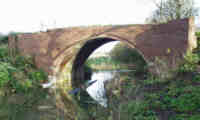
The Rucks Bridge restoration project started in 2006 and finished in 2009. The initial work mainly concentrated on repairs to the offside (north) lower abutment which was becoming compromised due to the disintegration of a row of stones at what was the original waterline. Some of these had broken up and sections of the brick wall above had collapsed due to lack of support. The damaged section of stonework are being replaced by hard engineering bricks following advice from British Waterways.
Working
on the lower parts of the structure would have been difficult due to
the presence of
rubble, silt and water both upstream and downstream of the bridge. The bridge hole was dug out using a hired
excavator by volunteers at the beginning of July 2007 in preparation
for the repair
of any defects in the lower towpath wall and abutments.
Water
used to flow down the canal for much of the year but new gravel pits
upstream of the work sites resulted in the failure of the water
feeders except in wet periods of weather. This made life easier but
does not bode well for keeping the canal in water prior to full
restoration.
The
work plan at Rucks Bridge is as complete as it can be with the main
part of the bridge and the channel walls underneath fully repaired. The
parapet walls cannot be rebuilt at the moment as large agricultural
machinery occassionally crosses the bridge.
|
|
3
Home | Location | History | Technical | Pictures | Background Information | Contacts | Links
This document is maintained by ken.burgin@pikelock.com .
Copyright © 2004-2011 Cotswold Canals Trust; all other rights reserved